
 😬 It’s not as healthy as you think from the field of Master Mind Particles (MMPART) 🤷♂️
Dear Zeolite Lover,
Do NOT take Zeolite – It was utilized for targeted nano-drug delivery.
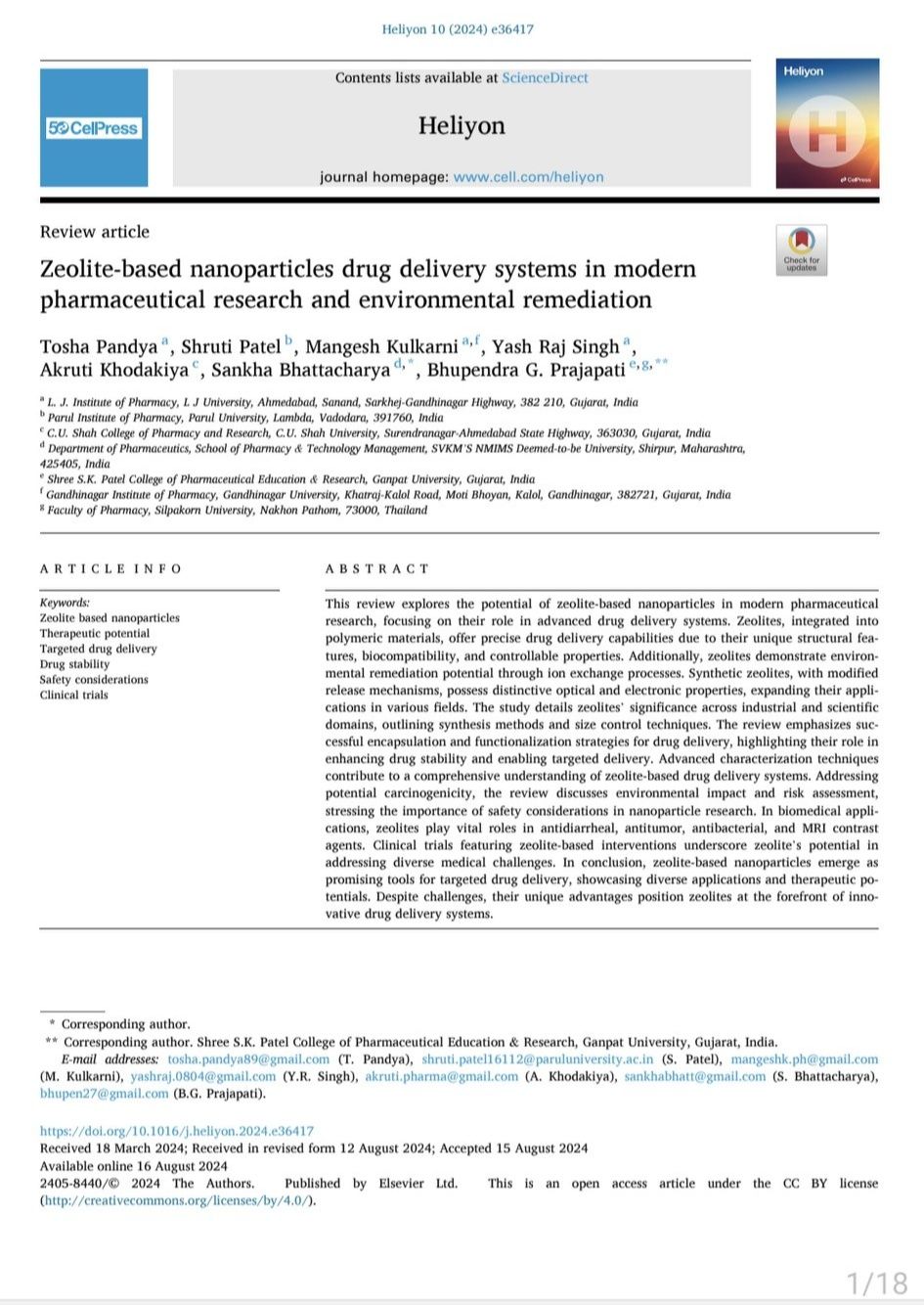
Zeolite-based nanoparticles drug delivery systems in modern pharmaceutical research and environmental remediation
https://www.sciencedirect.com/…/pii/S2405844024124486 (site proof has been removed).
• This review examines zeolite-based nanoparticles for drug delivery and environmental remediation.
• Zeolites’ unique structure, biocompatibility, and controllable properties make them suitable for precise drug delivery, particularly when integrated into polymeric materials.
• Their ion exchange capabilities are also valuable for environmental cleanup.
• The review details zeolite synthesis, size control, and successful drug encapsulation strategies, emphasizing enhanced drug stability and targeted delivery.
• While potential carcinogenicity is addressed, the review highlights zeolites’ biomedical applications, including antidiarrheal, antitumor, and antibacterial uses, and their role in MRI contrast agents.
• Clinical trials demonstrate their potential in addressing various medical challenges.
• Despite challenges, zeolites are promising for innovative drug delivery systems.
• This subset of MOFs possesses remarkable qualities due to their periodic pore systems, cage-like cavities, and modular components.
• A key advantage of ZMOFs is their variable pore sizes, enabling better drug loading and controlled release.
• Zeolites’ pore size and surface can be adjusted to meet specific drug delivery needs.
• Nanoparticulate drug delivery systems, including liposomes and metal-organic frameworks (MOFs), offer advantages over conventional methods due to their small size, large surface area, and ability to cross cell borders.
• Zeolites, a type of aluminosilicate with a porous structure, are particularly promising due to their adjustable pore size, enabling controlled drug loading and release.
• Research focuses on zeolite-based nanoparticles for drug delivery, utilizing databases like PubMed and Scopus to identify relevant studies, including in vivo and in silico research.
• Zeolites’ crystalline structure and porous nature make them suitable for drug encapsulation and controlled release, enhancing drug efficacy.
• Their adjustable surface properties and catalytic capabilities further contribute to their potential in drug delivery applications.
• Tailored delivery methods improve medicinal treatment efficiency and reduce negative side effects.
• However, widespread commercialization of zeolite-based nanoparticles faces challenges related to synthesis control and scalability.
• Zeolite nanoparticle morphology significantly impacts catalytic activity, selectivity, and stability.
• Researchers manipulate synthesis parameters (temperature, pH, etc.) and utilize various additives to control zeolite size and shape, achieving diverse morphologies (e.g., sheet-like, spherical) with varying catalytic performance.
• Studies also explore zeolite encapsulation for drug delivery, showing promising results in cancer treatment using 5-fluorouracil loaded into Linde Type L and Faujasite zeolites.
• Advanced characterization techniques, including FTIR, are crucial for understanding zeolite properties and optimizing their applications.
• XRD and NMR determine nanoparticle crystal structure for optimized drug loading.
• Microscopy reveals particle size, growth, and morphology crucial for drug delivery.
• Studies show morphological changes upon nanoparticle interaction and identify various nitrogen oxide adsorption species on Fe-loaded zeolites.
• Understanding these characteristics is vital for effective drug delivery systems.
Content Source: Jay Wilson
📸 Image of Zeolite Article 📄
 Email Us a Message

 Fly Over to the MMU Facebook Page with Hoot

 Join the MMU Facebook Group Today